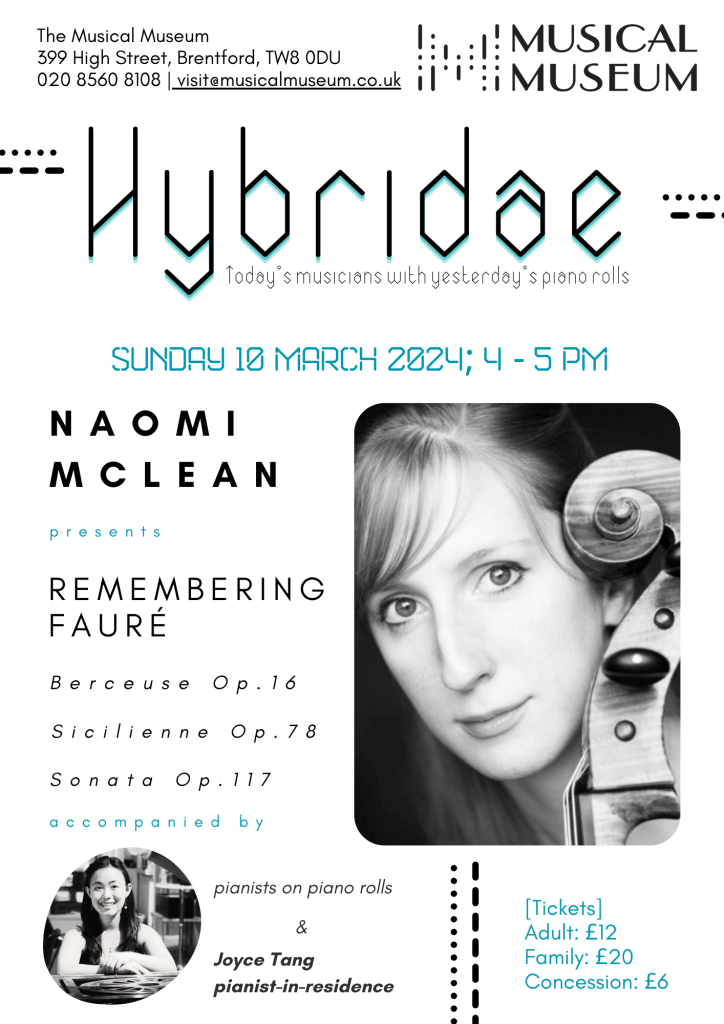
I have been quite absent from the blogging scene for a while. This post is to mark the launching of the first Hybridae concerts at the musical museum later today, starring the amazing cellist (and friend) Naomi Mclean. ‘Hybridae’ stems from word hybrid, and it is platform where I invite today’s musicians to play with myself, and with pianists on pianos rolls. Below is the program & program note:
Programme:
M. T. von Paradis: Sicilienne in E flat major
F. Mendelssohn: Song without Words in D major, Op. 109
G. Fauré: Sicilienne, Op. 78
G. Fauré: Prelude in Ab minor, Op.103 No.3 (played by G. Fauré, Welte-Mignon)
C. Saint-saëns: Le Cygne (accompaniment by Maurice Dambois, Duo-Art)
G. Fauré: Berceuse Op. 16 (accompaniment by Noel Gallon, Duo-Art)
G. Fauré: Sonata No. 2 in G minor, Op. 117
Gabriel Urbain Fauré (1845-1924) was a prominent French composer, organist, pianist, and teacher. Born into a cultured yet non-musical family, Fauré’s musical talent became evident in his youth. He received formal training at the École Niedermeyer in Paris, studying under notable figures like Camille Saint-Saëns. Throughout his career, Fauré’s music bridged the gap between Romanticism and the modernism of the 20th century. Fauré’s musical style evolved over time, with his early compositions being more accessible and well-known, and his later compositions being highly regarded in showcasing their harmonic innovations and refined melodic subtitles. Beyond his contributions as a composer, Fauré played a pivotal role in the French musical scene, holding influential positions and mentoring notable composers such as Maurice Ravel. Fauré’s retirement from the Paris Conservatoire in 1920 marked the end of an era, and he received a national tribute in 1922.
The concert featuring Fauré’s compositions promises a captivating exploration of the French composer’s diverse and evocative works. Berceuse, Op. 16, a short piece written around 1879, was dedicated to Hélène Depret, a pivotal figure in Fauré’s career. This piece showcases Fauré’s early success as a composer. Initially for solo violin and piano, the piece gained popularity through various arrangements and orchestrations. Sicilienne, Op. 78, originally conceived for a theatrical production, underwent transformations over the years, finding its place in a suite for full orchestra published in 1909. The arrangement for cello and piano came in 1898, created for Dutch cellist Joseph Hollman. Sonata No. 2 in G minor, Op. 117, emerged from Fauré’s commission to compose a funeral march for Napoleon’s centenary in 1921. The sonata, premiered in 1922, reflects Fauré’s late-career style, marked by its structural sophistication and emotional depth. The three movements, Allegro, Andante, and Finale—Allegro vivo, unfold with a seamless blend of sensitivity and canonic writing, creating a sonata that stands as a testament to Fauré’s artistic maturity.
The Prelude Op. 103 No. 3 is a unique insight into Fauré’s interpretative prowess. Recorded by Fauré himself on the Welte Mignon reproducing system before 1914, this recording captures the composer’s dedication to his craft even in the face of increasing deafness. The Prelude invites the audience to delve into the rich tapestry of Fauré’s piano compositions.
Maria Theresia von Paradis (1759-1824), an Austrian musician and composer, left an indelible mark on the classical music scene. Having lost her sight at an early age, she was renowned for her exceptional memory and precise hearing, In Paris, she gave 14 acclaimed performances and played a crucial role in establishing the first school for the blind in 1785. She is known for composing music for solo piano and for voice, but her most famous work is the Sicilienne in E-flat major for violin and piano. This work will be featured in today’s concert to commemorate 200 years since her passing and coinciding with Mother’s Day, a fitting tribute to this inspirational figure.
Fauré remained Camille Saint-Saëns’ (1835-1921) pupil for 60 years until Saint-Saëns’ death. Indeed, Saint-Saëns was good to his students: in 1886, his initial intention in composing the lighthearted suite Carnival of the Animals was for his students. The suite was heard at a private concert and was well-received, but Saint-Saëns insisted it wouldn’t be published during his lifetime, except for the famous cello solo, Le Cynge. This piece, published independently in 1887, became a staple of the cello repertoire. Interestingly, it was originally scored for a cello with two pianos.
Song without Words in D major, Op. 109 by Felix Mendelssohn (1809-1847) is originally for piano solo. Mendelssohn published 48 Songs without words throughout his life, and the works had widespread appeal due to the increasing ubiquity in middle-class households during the early nineteenth century. These wordless-song melodies have frequently been heard on instruments other than piano, and this particular one in D major is a favourite amongst cellists.
Bonne chance!
 Joyce Tang