
Just yesterday night, I was introduced to ChatGPT. Prompted to test the extent of its capabilities, I requested it to give a1000-word proposal on music and machine learning, with an informed bibliography. My first impression of ChatGPT’s response was one of both shock and delusion: shocked because the text was seemingly authoritatively presented, and grammatically coherent; delusion because I wasn’t really sure what the point it was trying to make and whether the evidence presented were entirely accurate.
This is a new-found territory for me, despite ChatGPT having launched in late November 2022 by OpenAI, and that there has been overheated discussions all over the web. For newbies like me, Chat GPT (Chat Generative Pre-Trained Transformer) is a chatbot: it is an AI assistant, and it mimics a human conversationalist to supervise learning and reinforce learning techniques. You type a question or a request, and receive information in writing for what you have asked it to do.
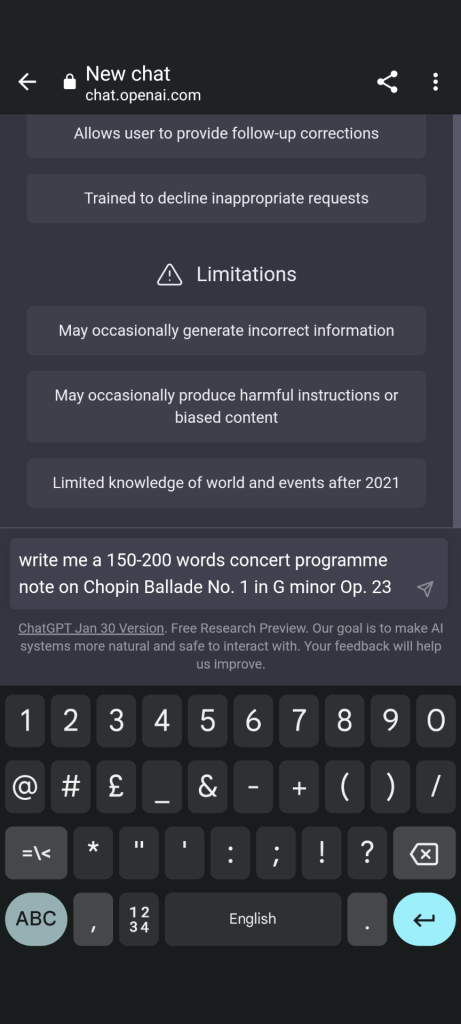
As fascinated as I am by this new ‘toy’, I currently know too little to make an informed judgement. This blog is a short one but serve as an introduction on this topic. In this blog, I simply point to three sources which I am starting to read, and it would be great to have more suggested in the comments. I then add my thoughts so far on ChatGPT, well, more like questions. Lastly, I show the response from the ‘task’ I set for ChatGPT to perform, which was to write ‘a 150-200 word concert programme note on Chopin Ballade No. 1 in G minor, Op. 23’ and ‘provide a bibliography’. In the next blog, I will focus on how to (and what to) evaluate in the given response (by ChatGPT), as I will need a bit of time to research the facts & think over its opinion!
Sources:
- ‘ChatGPT’, https://en.m.wikipedia.org/wiki/ChatGPT
- S. Harrison, ‘Should ChatGPT Be Used to Write Wikipedia Articles?’, https://slate.com/technology/2023/01/chatgpt-wikipedia-articles.html, Jan 12, 2023
- S. Shankland, ‘Why the ChatGPT AI Chatbot Is Blowing Everyone’s Mind’, https://www.cnet.com/google-amp/news/why-the-chatgpt-ai-chatbot-is-blowing-everyones-mind/ , Feb 4, 2023
Thoughts so far:
ChatGPT IS versatile and very handy to use: but to what level? Is the information accurate? How is ChatGPT helping us develop our critical thinking skills or creative writing / music composing skills? Should we be spoon-fed with knowledge, without going through the pains of acquiring knowledge?
And below the transcript of what ChatGPT wrote on the task I set out for it to do:
Frédéric Chopin’s Ballade No. 1 in G minor, Op. 23, is a stunning example of the composer’s virtuosic and expressive musical language. Composed in 1835, this piece is one of Chopin’s most famous works and is widely considered to be one of the greatest pieces of the Romantic era. The Ballade No. 1 is a complex, multi-movement work that is characterized by its sweeping melodies, virtuosic piano writing, and intense emotional content.
The piece opens with a powerful and dramatic introduction that sets the stage for the rest of the work. The main theme, which is introduced in the right hand, is both powerful and lyrical, and is surrounded by an intricate and virtuosic left-hand accompaniment. Throughout the piece, Chopin’s writing is both technically demanding and emotionally charged, as he explores a wide range of musical textures and moods.
As the Ballade No. 1 progresses, Chopin masterfully develops his themes, building up to a powerful climax that is both intense and cathartic. The final section of the piece is particularly stunning, as Chopin brings the work to a powerful and emotionally charged conclusion.
Overall, Chopin’s Ballade No. 1 in G minor, Op. 23, is a breathtaking piece of music that is sure to captivate and inspire audiences. Whether you are a seasoned classical music lover or a newcomer to the genre, this piece is a must-hear, and is sure to leave a lasting impression on anyone who experiences it.
“The Cambridge Companion to Chopin” edited by Jim Samson (Cambridge University Press, 1992)
“Chopin: His Life and Music” by James Huneker (Dover Publications, 1985)
“Frédéric Chopin: A Guide to Research” by Jim Samson (Routledge, 2002)
“Chopin: The Four Ballades” by John Rink (Cambridge University Press, 1992)
“Chopin Studies 2” edited by Jim Samson (Cambridge University Press, 1988)
“The World of Chopin: 1810-1849” by Jim Samson (Phaidon Press, 1979)
“Chopin: A Biography” by Tyrone Gregory (Greenwood Press, 2003)
“The Oxford Handbook of Chopin” edited by Jim Samson (Oxford University Press, 2014)
The chatbot ends on a rather shy note: ‘These resources may not be the most recent, as my knowledge cut off is 2021.’
 Joyce Tang