Some time ago, I had the above discussion with one of my mentee, and it was agreed that we would both have a read on two texts before our next meet.[i] This has turned out to be an interesting exploration, and so I feedback on my findings here.
This word arrangement probably came first, at a time when instrumental music were being distinguished from choral music, following the need to distinguish instruments from one another. In the Tudor period, categories of music were simple: things that were in pitch or not in pitch; and if in pitch, what register had it belonged to (high, medium, low). As noticed by Evlyn Howard-Jones, ‘up to and including the time of Bach and Handel we have evidence that much music was considered even by the composer as suitable in one form as in another, choral or instrumental, and even sacred or secular.’[ii] Scores were issued as ‘apt for voice or viols’: the composers did not mind, the performers did what sounded good, and the audience… possibly cared very little.
In the 17th and 18th century, we start seeing on music scores ‘arranged for…’, as well as other related terms such as Uebertragungen (adaptations) and Bearbeitungen (re-work). Transcription came a little later, palpably in the works of J.S. Bach. During this time, making arrangements implied the act of directly transferring a piece of music from one medium to another, whether that be another instrument or a voice. The changes were kept to a minimum: notes could be adapted in a more suitable register and occasional altered to other appropriate notes within the harmony. Transcription involved significantly re-writing, rearranging and composing of new materials. The famous Toccata and Fugue in D minor, BWV 565, the theme of which is heard in Disney’s Fantasia, science-fiction film Rollerball, and in Dr Who, is suspected to be a transcription of a violin original written by Bach himself.
Moreover, the method of notating music was not fussed in pre-Mozart time, and performers would usually improvise upon the music during performance. It was said that Bach was a great improviser, and I do love the story of how the Art of Fugue came to be:
It was on May 7, 1747, that Bach visited Frederick the Great at Potsdam. The Prussian king preferred the pianoforte — then called ”forte and piano” — to the less nuanced harpsichord or the organ; so much so that he had 15 of the instruments built for him. During this visit the king led Bach from room to room to try them out. Frederick played for Bach a theme of his own and then asked Bach to improvise a fugue on it. After Bach obliged with a three-voice fugue, the king demanded a more spectacular six-voice fugue. Bach improvised a six-voice fugue on a theme of his own, but on his return to Leipzig wrote out a six-voice fugue on the royal theme. He had it printed with a number of other works all based on the same theme, and sent it to Frederick as ”a musical offering.”[iii]
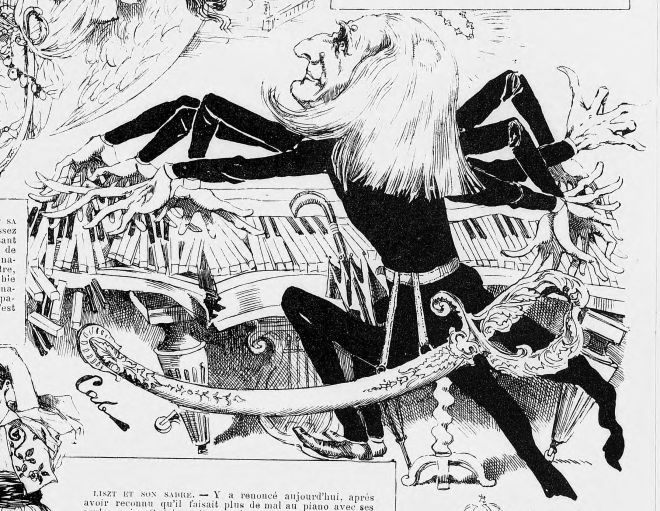
Perhaps it was a form of claiming copyright, and making a profit from publishing arrangements or transcriptions that these terms were ‘officiated’ on paper. In performance, the concert virtuosos, particularly of instrumentalists such as Paganini on the violin and Liszt on the piano, wooed the public with popular tunes as heard in opera and in folklore. As well as being a great pianist and a famous composer, Franz Liszt was notorious for his transcriptions on other composer’s compositions, from Bach’s organ preludes to Paganini’s etudes to Schubert songs and Wagner’s operas. Liszt did not just arrange pieces to make them possible to play on the piano, he transcribed them so that pieces exhibited the full potentials of the instruments. In Liszt and him after, transcriptions sound far removed from the original, and bear little resemblance: sometimes you recognise the melody, the rhythm, and maybe the harmony.

The rise of pianos in domestic homes from the nineteenth century further pushed market demands for arrangements and transcriptions. People of all pianist levels can play simplified and complicated versions of popular tunes. Instruments that have little music written for them, such as accordion, also relied on arrangements and transcriptions. However, ‘arrangements’ in 19th and 20th century have a different essence to that in the 17th and 18th century. One main reason is that there in an increased choice of instruments, therefore an increased consideration for timbral differences. As a result of this, there are many possibilities to arrangement – orchestrations, ensembles, small groups, solo instruments. Would something sound good or better if the notes were left as they were? From what do one make their arrangements from? The original? The arranged? Or the transcription? There are a lot of options, and as a result, they challenged the boundaries between something that is ‘arranged’ and something that is ‘transcribed’.
Nowadays, people tend to use the word ‘cover’. Based on what is out there on youtube, the word ‘cover’ covers a spectrum of possibilities which includes arrangements and transcriptions. On the basic end you have people doing exact renditions of a song, singing to the same backing track and backing vocals as used by the original artist. In the ‘arrangement’ sense you have peole who have input some of their own creativity and changed instrumentations. There are people who added their own flare in both accompaniment and melodic part, but nothing much to deviate from the original structurally. And then there are remixes, DJs, who transforms music with different moods – is that considered a form of transcription? On the western-classical tradition, there is seeminly less attempts by composers to make arrangements and transcriptions of compositions in the twentieth century: of Stravinsky maybe, but not of Xenakis or Nancarrow. Some pianists do incorporate their own arrangements and transcriptions of orchestral works in their performances. Perhaps we are returning back to pre-Elisabethan time: the focus is on the music being performed, and less so of the creator.
[i] BROUDE, R. (1977). Arrangement, Transcription, Edition: Some problems in terminology. The Choral Journal, 18(1), 25–29. Howard-Jones, E. (1935). Arrangements and Transcriptions. Music & Letters, 16 (4), 305–311.
[ii] Howard-Jones, E, Arrangements and Transcriptions, 305.
[iii] Rosen, Charles. (1999). From Best Piano Composition: Six Parts Genius. New York Times, April 18, https://www.nytimes.com/1999/04/18/magazine/best-piano-composition-six-parts-genius.html, consulted 19/11/22.
[iv] La Vie parisienne : moeurs élégantes, choses du jour, fantaisies, voyages, théâtres, musique, modes, 3 April 1886, 195.
 Joyce Tang