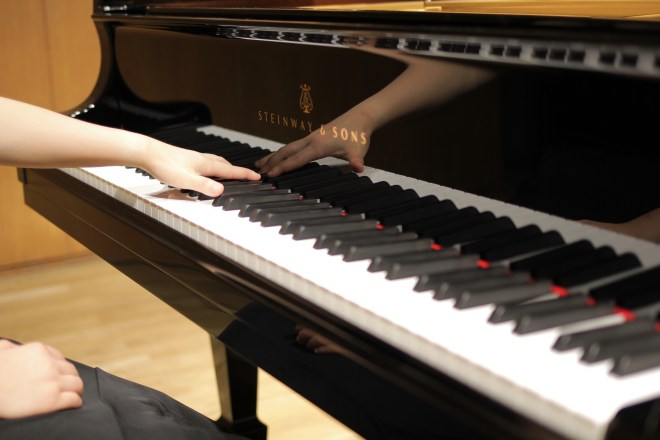
Today’s post is going to take an abrupt shift from the usual research-related topics. As a piano teacher, I have often been asked the ‘when’ questions for starting piano lessons, both from parents asking on behalf of their child, and from adults who simply wants to give piano a go. Whilst this post is not about giving advice on what is the best age to start piano lessons, it is going to make us think about why one should play & create music through an instrument such as a piano. We are going to this by exploring 3Ps: Perspective, Pleasure, Persistence.
Perspective:
Music broadens the perspective into life. Whether or not we engage with music voluntarily or involuntarily, it is inbreed in every culture, and reflect all kinds of circumstances in life. Not only do we listen to music through auditory and emotional senses, we attend to it ‘with our muscles’.[i] Music encapsulates every being, and not solely influencing and interacting with one’s body, as recent medical and scientific research have revealed an even closer association between music and neural circuitry:
“through studies of people with brain damage, we’ve seen patients who have lost the ability to read a newspaper but can still read music, or individuals who can play the piano but lack the motor coordination to button their own sweater. music listening, performance, and composition engage nearly every area of the brain that we have so far identified, and involve nearly every neural subsystem.”[ii]
Additionally, learning an instrument brings about a counterintuitive perspective to those of generation z and generation alpha. today’s technology have made it possible to allow for instant results and gratification; information is passing through at such a quick rate that one does not have time to appreciate it for what it is. however, this is not what learning an instrument is about. learning an instrument is a skill to enjoy for life; there are moments where one will reap and see results and be rewarded with gratification, but those moments are traded with plenty times of repetitive and tedious tasks. contrary to the view of seeing things for ‘what’s in it for me’, music making is about giving rather than receiving. making music requires one to invest their entire self, as pianist alfred cortot harshly said: “breathe the breath of life into this music, or do not play the piano at all”.[iii]
Pleasure:
I don’t think I need to write too much about this. Take a look at how many Instagram or tiktok videos there are of piano playing, and the number of views on these, and one recognises that people do find it immensely pleasurable to play and hear music on the piano. There is something about the tinkling on the keys, the dancing hammers, and the beauty of the design that makes one appreciate the instrument just by its looks along. The sound, well, of course we prefer a good quality piano being played by a good pianist, but as pianist Charles Rosen once said, “professional musicians and connoisseurs tend to forget that even music badly played can sound beautiful and give pleasure.”[iv] Making music is finding pleasure for oneself as well as sharing this pleasure with others.
Persistence:
Let’s face it, the piano is a hard instrument to learn. At the outset, there is the skill to read a musical score: that in itself is like learning a new language, and sometimes learning more than one new language because you have all these composers who wrote in all sorts of foreign texts. One may bypass this step and learn music aurally (such as the Suzuki and Kodaly methods), but the traditional way of learning encourages one to then connect learnt cognitive knowledge about music reading and translate them into a practical skillset: coordinate up to 4 limbs, not to mention also all the micro joints of each. It takes time to do all of this, practice, and get better. There are no shortcuts.
But why does it look that much easier for some people? Like, it can be done in a matter of hours? You are not alone in thinking why it takes so long to learn a particular piece. People do put in the hours of practice, with conscious or unconscious efforts. My mother passed the ABRSM Grade 6 last year, practising her 4 pieces over and over again for an hour each day for almost 2 years, and not once did she complained (but my father did! ‘You are practising the piano again!’). One can avoid pitfalls and use time effectively if you have access to good guidance, and supporters to encourage you along. In the long run, it is a process of studying, and a process of building one’s character of patience and persistency. The same conclusion was drawn from a study conducted on child prodigies, that “music, including piano lessons, can give a catalytic effect in education, so that the goal in studying the piano may be learning how to learn, with the acquired piano skills counting merely as a byproduct.”[v]
At the end of the day, making music on the piano is enjoyable. It draws people around, and also allow for those special moments of solitude.

[i] Sacks, O. (2008). O., Musicophilia: Tales of music and the brain. New York: Alfred A. Knopf, xii.
[ii] Levitin, D. (2006). This is Your Brain on Music: The Science of a Human Obsession. Penguin: Plume, 9.
[iii] Cortot, A. (1937). Alfred Cortot’s Studies in Musical Interpretation. Harrap. I think the quote was from this book, I had it written down during my teenage years.
[iv] Rosen, C. (2015). Piano notes, The hidden World of Pianists. London: Penguin.
[v] Simka, A. (1982). ‘The Gifted Child and the Piano: The Elementary Years’. American Music Teacher, 31(4), 16–18. http://www.jstor.org/stable/43538492, consulted 07/09/22.
 Joyce Tang